Cerebrolysin: The Definitive Guide to Neurotrophic Peptide Therapy
A Comprehensive Scientific Analysis of History, Mechanisms, Clinical Evidence, and Practical Applications
Table of Contents
A Comprehensive Scientific Analysis of History, Mechanisms, Clinical Evidence, and Practical Applications
Executive Summary
Cerebrolysin represents one of the most extensively studied neuropeptide preparations in modern medicine—a sophisticated bioactive compound derived from porcine brain tissue that has accumulated over 70 years of clinical research and more than 200 published studies. Unlike conventional pharmaceuticals that target single pathways, this peptide complex activates multiple upstream signaling cascades simultaneously, producing a constellation of neurorestorative effects that range from enhanced synaptic plasticity to accelerated post-injury recovery.
The compound has earned recognition from the European Academy of Neurology, which issued its strongest recommendation for Cerebrolysin in post-stroke rehabilitation guidelines. Clinical meta-analyses demonstrate statistically significant improvements in cognitive function, motor recovery, and quality of life across diverse neurological conditions including Alzheimer's disease, traumatic brain injury, stroke, and multiple sclerosis.
This guide synthesizes the current state of scientific knowledge, dissecting the molecular mechanisms that underpin Cerebrolysin's therapeutic effects while providing evidence-based dosing protocols for clinical and optimization applications.
Part I: Origins and Composition
Historical Development
The story of Cerebrolysin begins in post-war Austria, where Dr. Gerhard Harrer first developed the preparation in 1949. By 1954, the compound had entered clinical use across Europe, establishing a therapeutic legacy that now spans seven decades. The preparation is manufactured by EVER Neuro Pharma (Austria) through a proprietary enzymatic hydrolysis process that breaks down porcine brain tissue from pigs under one year of age into bioavailable peptide fragments.
Molecular Architecture
Mass spectrometry analysis has revealed Cerebrolysin's remarkable complexity. The preparation consists of approximately 80% amino acids and 20% low molecular weight peptides, with high-performance liquid chromatography identifying 638 unique peptides within the solution.
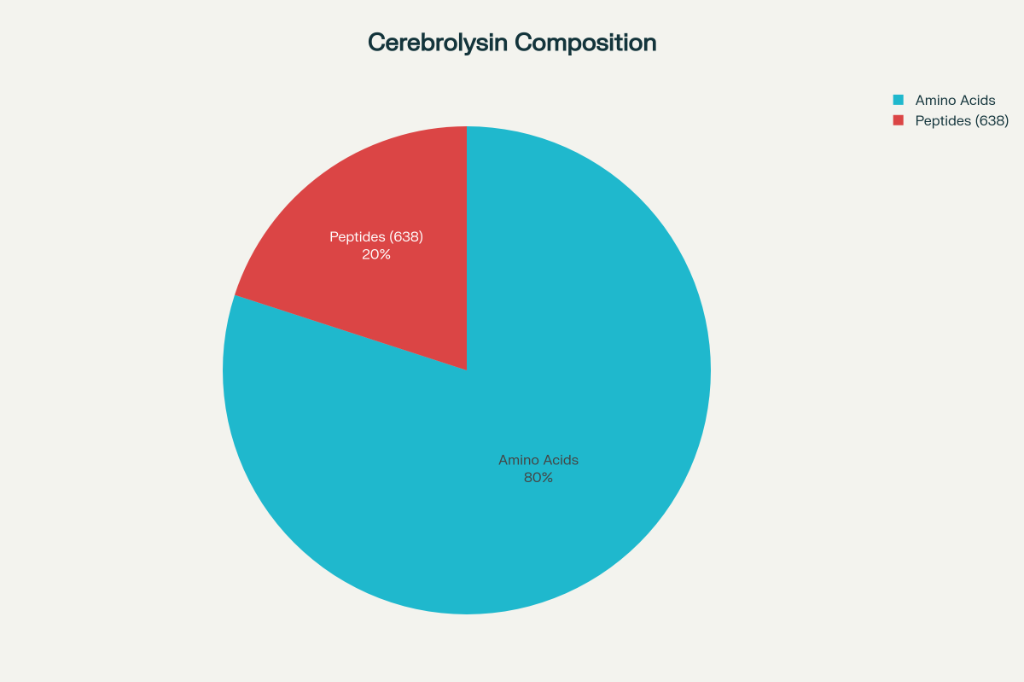
Cerebrolysin Composition
These peptides derive primarily from:
- Tubulin alpha- and beta-chains
- Actin proteins
- Myelin basic protein
A more extensive proteomic analysis identified 14,635 peptides corresponding to 1,643 porcine neuronal proteins, including fragments that mimic 300 known biologically active peptides—among them Leu- and Met-enkephalins, orexin fragments, galanin, and nerve growth factor components.
What Cerebrolysin Does NOT Contain
Contrary to persistent misconceptions, rigorous testing has confirmed that Cerebrolysin does not contain full-length neurotrophic factors such as BDNF, NGF, or CNTF. These proteins exceed the 10,000 Dalton molecular weight limit of the preparation. Earlier studies using ELISA testing methods generated false positives due to detection of epitopes (structurally similar fragments), but more stringent LC-MS analysis has definitively ruled out their presence.
This distinction proves therapeutically significant: research demonstrates that directly supplying neurotrophic factors to neurons often fails to produce structural changes, whereas stimulating their endogenous production through specific pathway activation yields pronounced benefits.
Part II: Mechanisms of Action
The Five Major Upstream Pathways
Cerebrolysin exerts its neurorestorative effects through five primary signaling cascades, each triggering distinct downstream mechanisms:
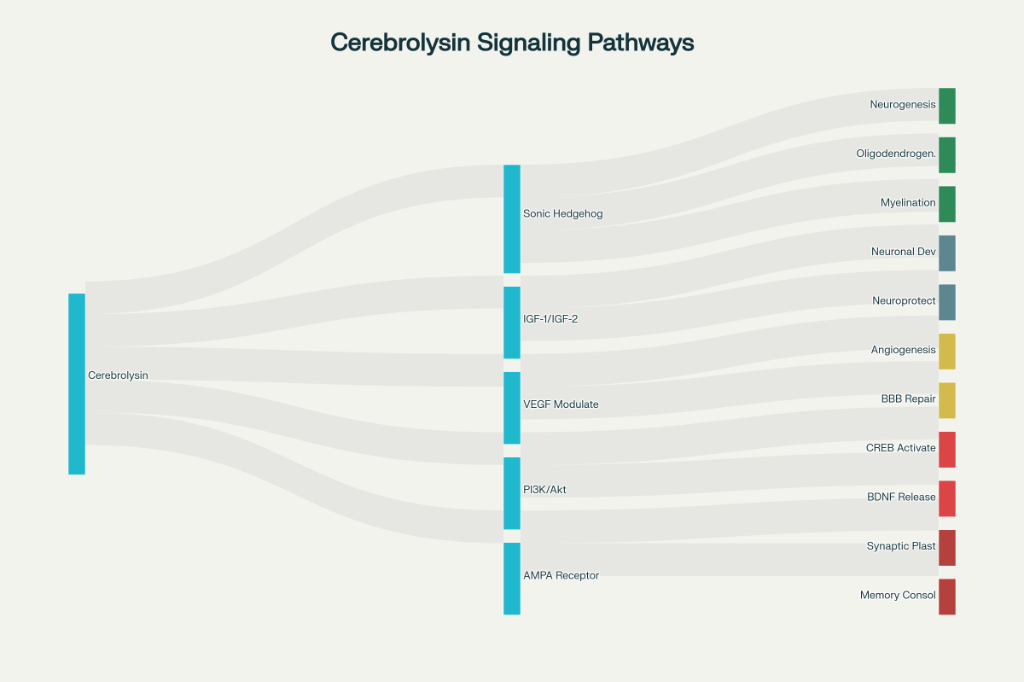
Cerebrolysin Signaling Pathways
1. Sonic Hedgehog (Shh) Pathway
The Sonic Hedgehog signaling pathway serves as Cerebrolysin's primary regenerative mechanism. Research using post-stroke models has demonstrated that blocking Shh signaling with cyclopamine (a smoothened receptor antagonist) completely abolishes Cerebrolysin's benefits, including neuroprogenitor proliferation and differentiation into neurons and oligodendrocytes.
Key downstream effects:
- Upregulation of Shh receptors (Patched-1 and Smoothened)
- Enhanced neurogenesis in the subventricular zone
- Oligodendrogenesis and subsequent myelination
- ERK1/2 activation promoting oligodendrocyte maturation
The oligodendrocyte differentiation pathway proves particularly significant, as these cells produce myelin—the insulating sheath essential for fast, efficient neural conduction and remyelination after injury.
2. Insulin-Like Growth Factor (IGF-1/IGF-2) Axis
Clinical studies in Alzheimer's patients demonstrate that Cerebrolysin increases circulating IGF-1 in a dose-dependent manner while simultaneously reducing the pro-inflammatory cytokine TNF-alpha. Greater IGF-1 elevations correlate with superior functional outcomes.
Downstream mechanisms:
- Stimulation of neuronal progenitor cells
- Enhancement of synaptic plasticity
- Upregulation of Group 1 metabotropic glutamate receptors
- Improved AMPA receptor trafficking
3. Vascular Endothelial Growth Factor (VEGF) Modulation
Cerebrolysin demonstrates context-dependent VEGF regulation—a characteristic reminiscent of Professor Vladimir Khavinson's bioregulator classification. In Alzheimer's disease, where elevated VEGF often accompanies late-stage pathology, Cerebrolysin reduces VEGF levels. In stroke recovery, it increases VEGF signaling to promote angiogenesis and blood-brain barrier repair.
4. PI3K/Akt/CREB Cascade
Cerebrolysin activates the PI3K/Akt pathway, leading to phosphorylation of CREB (cAMP Response Element Binding protein). CREB then binds to promoter regions of neuroplasticity-related genes including BDNF, NR4A1, and c-Fos, initiating transcription that supports:
- Neurogenesis
- Synaptic strengthening
- Long-term potentiation
- Memory consolidation
5. AMPA Receptor Trafficking
Post-stroke recovery studies reveal that Cerebrolysin significantly upregulates the GluA1 subunit of AMPA receptors in the hippocampus while NMDA receptor levels remain unchanged. This selective enhancement creates a positive feedback loop:
AMPA activation → Calcium influx → BDNF release → Synaptic growth → Enhanced AMPA receptor trafficking
The amplified AMPA signaling also improves cerebral vasodilation, benefiting cognition in vascular dementia through increased blood flow to central processing regions.
Secondary Mechanisms
Beyond the primary pathways, Cerebrolysin engages several additional therapeutic mechanisms:
Caspase-3 Inhibition: Reduces apoptosis by inhibiting this key cell death enzyme, well-documented to increase following nervous system trauma.
PON-1 Restoration: Reactivates paraoxonase-1 enzyme, protecting against oxidative stress and neurotoxins.
Enkephalin System Modulation: Contains peptide fragments that interact with endogenous opioid receptors, providing analgesic and anxiolytic effects without addiction liability.
Orexin-Like Activity: Peptide analysis confirms orexin fragments within Cerebrolysin, potentially explaining reported improvements in wakefulness, alertness, and motivation.
Kynurenic Acid Reduction: Inhibits enzymes producing this neurotoxin that impairs cognition.
Glutamate Transporter Enhancement: Protects against excitotoxicity by improving glutamate clearance—a major mechanism of neuron damage in stroke and brain injury.
Part III: Clinical Evidence by Condition
Alzheimer's Disease
Meta-analyses of six randomized controlled trials comparing Cerebrolysin to placebo have established statistically significant benefits:
| Outcome Measure | Effect Size | Statistical Significance |
|---|---|---|
| Cognitive Function (4 weeks) | SMD -0.40 | p = 0.0031 |
| Global Clinical Change (4 weeks) | OR 3.32 | p = 0.0212 |
| Global Clinical Change (6 months) | OR 4.98 | p = 0.0150 |
| Combined Global Benefit (4 weeks) | MW 0.57 | p = 0.0006 |
Clinical trials demonstrate that Cerebrolysin at 10 ml/day proved more effective than donepezil (a cholinesterase inhibitor) alone, with combination therapy producing superior results to either intervention individually. The combination synergistically increased serum BDNF levels, with BDNF responses significantly higher in ApoE4 allele carriers—a population at elevated Alzheimer's risk.
Beyond symptomatic improvement, preclinical research reveals Cerebrolysin's disease-modifying potential:
- Reduced amyloid-beta production by shifting APP processing away from beta-secretase cleavage toward neuroprotective alpha-secretase processing
- Restored GLUT-1 expression (the main glucose transporter at the blood-brain barrier), addressing the central insulin resistance that drives Alzheimer's pathophysiology
- Decreased hyperphosphorylated tau and normalized DRP-1 expression in models of frontotemporal dementia
Stroke Recovery
The Cerebrolysin and Recovery After Stroke (CARS) trial and subsequent studies establish Cerebrolysin as an effective add-on therapy in post-stroke rehabilitation:
A recent systematic review and meta-analysis of 14 randomized controlled trials (N = 2,884 patients) found:
- Significantly improved neurological recovery: Mean difference in NIHSS change of +1.39 points (95% CI: 0.53-2.25; p = 0.020)
- Reduced hemorrhagic transformation: RR = 0.55 (95% CI: 0.32-0.92)
- Comparable safety to placebo: No significant differences in serious adverse events (RR = 1.08)
These findings led to Cerebrolysin's inclusion in the European Academy of Neurology guideline on pharmacological support for motor rehabilitation after acute ischemic stroke, receiving the strongest recommendation level (30 ml/day IV, minimum 10 days, initiated within 7 days of acute stroke).
Mechanistically, stroke studies demonstrate that Cerebrolysin:
- Stabilizes neuronal structural integrity via calpain inhibition
- Induces neuronal sprouting and neurogenesis
- Reduces infarct volume
- Promotes functional recovery even when administered 24+ hours post-stroke
Traumatic Brain Injury (TBI)
The CAPTAIN trials evaluated Cerebrolysin in moderate to severe TBI patients across multiple centers:
Key findings:
- Faster recovery times with greater improvements in GCS/GOS scores
- Reduced hospital stays compared to standard treatment alone
- Large effect size (0.73) on anxiety reduction
- Decreased pro-inflammatory cytokines (IL-1β, IL-6, TNF-α, NF-κB) in TBI patients
Preclinical research reveals the mechanistic basis: Cerebrolysin alleviates brain edema, reduces neuroinflammation, and prevents neuronal apoptosis through modulation of the TLR signaling pathway. The combination with 5-HT6 receptor antagonists produced synergistic neuroprotection exceeding either compound alone, supporting the "stacking" principle in peptide therapy.
In recovery studies, patients receiving Cerebrolysin (10 ml twice daily for 3 weeks) demonstrated faster achievement of rehabilitation milestones—including time to first knee extension and time to first walk between parallel bars—compared to controls receiving identical physical therapy protocols.
Multiple Sclerosis
Clinical investigation in 40 patients with remitting MS during relapse regression demonstrated Cerebrolysin's potential for stimulating remyelination. The treatment group showed:
- More pronounced improvement in cognitive-motor function testing (SDMT, p = 0.038)
- Greater regression of neurophysiological abnormalities on comprehensive examination (70.59% vs. 27.78%, p = 0.028)
- No increase in gadolinium-enhancing lesions on MRI
The remyelination potential relates directly to Cerebrolysin's composition, which includes fragments of tubulin, actin, and myelin basic protein—components essential for non-specific trophic support of regenerating CNS myelin.
Parkinson's Disease
Research using the 6-OHDA rat model demonstrates Cerebrolysin's therapeutic potential in Parkinson's:
- Restored dopamine levels in midbrain and striatum
- Normalized oxidative stress markers (MDA, NO) while increasing glutathione
- Improved behavioral performance correlating with biochemical improvements
- Neuroprotection via reduced alpha-synuclein and nNOS expression (with nanodelivery)
Combined cerebrolysin and lithium therapy in the reserpine-induced PD model ameliorated oxidative stress parameters, acetylcholinesterase activity, and monoamine concentrations while improving the histopathological picture.
Anxiety and Depression
Secondary analysis of TBI trial data reveals Cerebrolysin's mental health benefits:
- Large effect size (0.73) on anxiety levels
- Statistically significant improvements in HADS-Anxiety scores at follow-up visits
- Synergistic enhancement of lithium's antidepressant effects in depression models
- Reduction in HADS Depression scores, with 70.5% of treated patients achieving scores of 0-7 compared to 39.5% of placebo patients
The anxiolytic mechanism likely involves modulation of the enkephalin system and GABA receptors, while antidepressant effects correlate with enhanced BDNF signaling.
Peripheral Nerve Injury and Diabetic Neuropathy
Cerebrolysin improves peripheral nervous system function through multiple mechanisms:
In diabetic peripheral neuropathy models:
- Increased number, diameter, and area of myelinated sciatic nerve fibers
- Improved inclined plane test performance (body position maintenance)
- Enhanced pain sensitivity (indicating restored nerve function)
- Improved sciatic function index
Clinical observations report faster neurological recovery after various peripheral nerve lesions compared to steroids and supportive therapies. The preparation enhances Schwann cell reorganization and functions relevant to nerve regeneration.
Part IV: Dosing Protocols and Administration
Clinical Dosing Recommendations
| Condition | Daily Dosage | Treatment Initiation | Duration |
|---|---|---|---|
| Stroke | 20-50 ml | As soon as possible | 10-21 days |
| Traumatic Brain Injury | 20-50 ml | As soon as possible | 7-30 days |
| Vascular Dementia | 10-30 ml | As soon as possible | 1 cycle: 5 days weekly/4 weeks; 2-4 cycles per year |
| Alzheimer's Disease | 10-30 ml | As soon as possible | 1 cycle: 5 days weekly/4 weeks; 2-4 cycles per year |
| Mild Cases | 1-5 ml | Per clinical judgment | Variable |
| Severe Cases | 10-30 ml | Per clinical judgment | Variable |
Routes of Administration
Intravenous Infusion (10-50 ml):
- Dilute to minimum 100 ml total volume with 0.9% NaCl, Ringer's solution, or 5% glucose
- Infuse over 15-60 minutes
- Best experience with 30-45 minute infusion times
- Morning administration preferred (compound is stimulating)
Intravenous Push (up to 10 ml):
- Inject undiluted over 3 minutes
- Administer immediately after opening ampule
- Flush before and after with 0.9% NaCl
Intramuscular Injection (up to 5 ml):
- Inject slowly over 3 minutes
- Multiple injection sites may be used to achieve higher daily dosages
- Equivalent safety to IV administration; comparative efficacy data limited
Intranasal Administration:
- Experimental route not supported by clinical trials
- Theoretically bypasses blood-brain barrier
- Risk of inconsistent dosing (dripping, throat deposition)
- May be appropriate for specific applications (anosmia recovery)
- Clinical evidence limited to animal studies
Timing Considerations
Optimal administration occurs in the morning, as Cerebrolysin's stimulating properties may affect sleep if given later. Fasted administration may optimize peptide absorption. Clinical trials typically administer treatment for defined cycles with rest periods between courses.
Part V: Safety Profile
Clinical Safety Data
Cerebrolysin demonstrates an exceptional safety profile validated across decades of clinical use:
Large-Scale Trial Data (N = 1,069 stroke patients):
- Adverse event incidence similar between Cerebrolysin and placebo groups
- No significant group differences in laboratory parameters
- No cardiac, hepatic, or renal toxicity
- Mortality: 5.3% Cerebrolysin vs. 5.9% placebo (hazard ratio 1.26, favoring treatment)
Meta-Analysis Findings (N = 2,884 patients):
- No significant differences in serious adverse events (RR = 1.08; 95% CI: 0.84-1.40)
- No significant differences in mortality (RR = 0.86; 95% CI: 0.68-1.09)
- Reduced hemorrhagic transformation risk (RR = 0.55; 95% CI: 0.32-0.92)
Reported Adverse Reactions (rare and transient):
- Dizziness
- Agitation
- Feeling of warmth/flushing
- Flu-like syndrome (uncommon)
- Confusion or anxiety (rare)
According to European Medicines Agency classification, Cerebrolysin falls within the SAFE category. High-dose studies (up to 50 ml daily) and long-term protocols (up to 3 years) have not revealed unexpected safety signals.
Contraindications and Precautions
Seizure History: Cerebrolysin may slightly increase seizure risk. Patients with epilepsy or seizure predisposition should consider alternative neuropeptide options such as cortexin.
Severe Allergies: History of multiple serious drug allergies warrants caution.
Combination with Other Medications: Cerebrolysin should not be mixed in the same infusion with amino acid solutions, vitamins, or cardiovascular medications.
Part VI: Quality and Sourcing Considerations
Authentic vs. Generic Preparations
Research comparing peptide preparations allegedly similar to Cerebrolysin has revealed significant differences. A 2024 study found that only authentic EVER Pharma Cerebrolysin triggered EGFP-NFL expression (a key marker of neuronal differentiation and repair), while alternative preparations—including Chinese-manufactured versions and cerebral protein hydrolysates marketed as substitutes—demonstrated inferior or absent biological activity.
Key differentiators:
- Clinical trials overwhelmingly use EVER Pharma brand Cerebrolysin
- Peptide composition analysis reveals significant differences between authentic and generic preparations
- "Cerebrolysin-like" products may lack therapeutic equivalence
Verification Recommendations
- Source from authorized distributors or pharmacies
- Verify EVER Neuro Pharma manufacturing origin
- Check lot numbers and expiration dates
- Proper storage: refrigerated, protected from light
Part VII: Synergistic Stacking Protocols
Evidence-Based Combinations
Research supports enhanced outcomes when Cerebrolysin is combined with complementary interventions:
Cerebrolysin + Donepezil (Alzheimer's):
- Synergistic BDNF elevation
- Enhanced and prolonged cognitive benefits
- Superior outcomes to either agent alone
Cerebrolysin + 5-HT6 Antagonists (TBI):
- Greater neuroprotection than either compound alone
- Dual action: structural restoration + neurochemical signaling enhancement
- Particularly valuable in cases with sleep dysfunction or cognitive fatigue
Cerebrolysin + Lithium (Depression/Parkinson's):
- Potentiated antidepressant effects
- Improved monoamine restoration
- Enhanced histopathological outcomes
Cerebrolysin + Physical Rehabilitation (Stroke):
- Accelerated motor recovery
- Earlier achievement of functional milestones
- Standard of care in European stroke rehabilitation guidelines
Complementary Peptides
Based on mechanistic overlap and synergistic potential:
- Pinealon: Enhances BDNF via FNDC5/irisin pathway; proven in Alzheimer's models
- Vesugen: Addresses metabolic and vascular contributions to neurodegeneration
- Cortexin: Alternative for seizure-prone individuals; similar neuroprotective profile
Part VIII: Practical Implementation Guide
Pre-Treatment Considerations
- Baseline Assessment: Document cognitive, motor, and functional status
- Contraindication Review: Screen for seizure history, severe allergies
- Timing Optimization: Schedule morning administration
- Combination Planning: Identify synergistic interventions
Treatment Monitoring
- Cognitive testing at baseline and defined intervals
- Functional outcome scales appropriate to condition
- Subjective symptom tracking (anxiety, mood, energy, mental clarity)
- Adverse event documentation
Expected Timeline
- Acute effects (20-60 minutes): Many report subjective improvements, particularly before demanding tasks
- Short-term benefits (1-4 weeks): Measurable cognitive and functional improvements in clinical trials
- Sustained effects: Benefits maintained for months after treatment cessation in Alzheimer's studies
- Cumulative optimization: Repeated treatment cycles may produce progressive improvements
Conclusion
Cerebrolysin stands as one of the most thoroughly researched neuropeptide therapies available, supported by over 200 clinical and preclinical studies spanning seven decades. Its unique multi-pathway mechanism—activating Sonic Hedgehog signaling, IGF-1/IGF-2 axes, VEGF modulation, PI3K/Akt/CREB cascades, and AMPA receptor trafficking simultaneously—produces a comprehensive neurorestorative effect unmatched by single-target pharmaceuticals.
The clinical evidence demonstrates statistically significant benefits across the spectrum of neurological conditions: cognitive improvement in Alzheimer's disease, accelerated recovery after stroke and traumatic brain injury, remyelination support in multiple sclerosis, dopamine restoration in Parkinson's disease, and anxiolytic effects across indications.
With an exceptional safety profile validated in trials involving thousands of patients, Cerebrolysin represents a well-characterized tool for neurological optimization and recovery. The European Academy of Neurology's strong recommendation for post-stroke rehabilitation reflects the strength of available evidence.
For those pursuing cognitive enhancement or neurological recovery, Cerebrolysin offers a scientifically validated approach grounded in decades of research and clinical application—a peptide complex that works with the brain's endogenous repair mechanisms rather than attempting to override them.
References and Clinical Evidence Base
This article synthesizes findings from over 200 published studies on Cerebrolysin, including:
- Multiple meta-analyses of randomized controlled trials
- The CARS (Cerebrolysin and Recovery After Stroke) trial series
- The CAPTAIN (Cerebrolysin Asian Pacific Trial in Acute Brain Injury and Neurorecovery) trials
- European Academy of Neurology stroke rehabilitation guidelines
- Proteomic composition analyses
- Mechanistic studies on Sonic Hedgehog pathway mediation
- Long-term safety surveillance data
This article is intended for educational and informational purposes. Cerebrolysin is an approved medication in various countries and should be used under appropriate medical supervision. Availability and regulatory status vary by jurisdiction.