Protocol
Peptide Storage 101: Fridge, Freezer, or Shelf?
Do not ruin your expensive vials. Learn the exact shelf life of lyophilized vs. reconstituted peptides and how to prevent degradation.
ByPeptide Bioregulator Atlas (Adapted)
April 26, 2024
Table of Contents
The Fragility of Peptides
Peptides are fragile chains of amino acids held together by peptide bonds. They are susceptible to denaturation(unraveling) from three enemies:
- ** Heat ** (Kinetic energy breaks bonds).
- ** Light ** (UV radiation damages structure).
- ** Agitation ** (Shaking can shear large peptides like HGH).
1. Lyophilized(Powder Form)
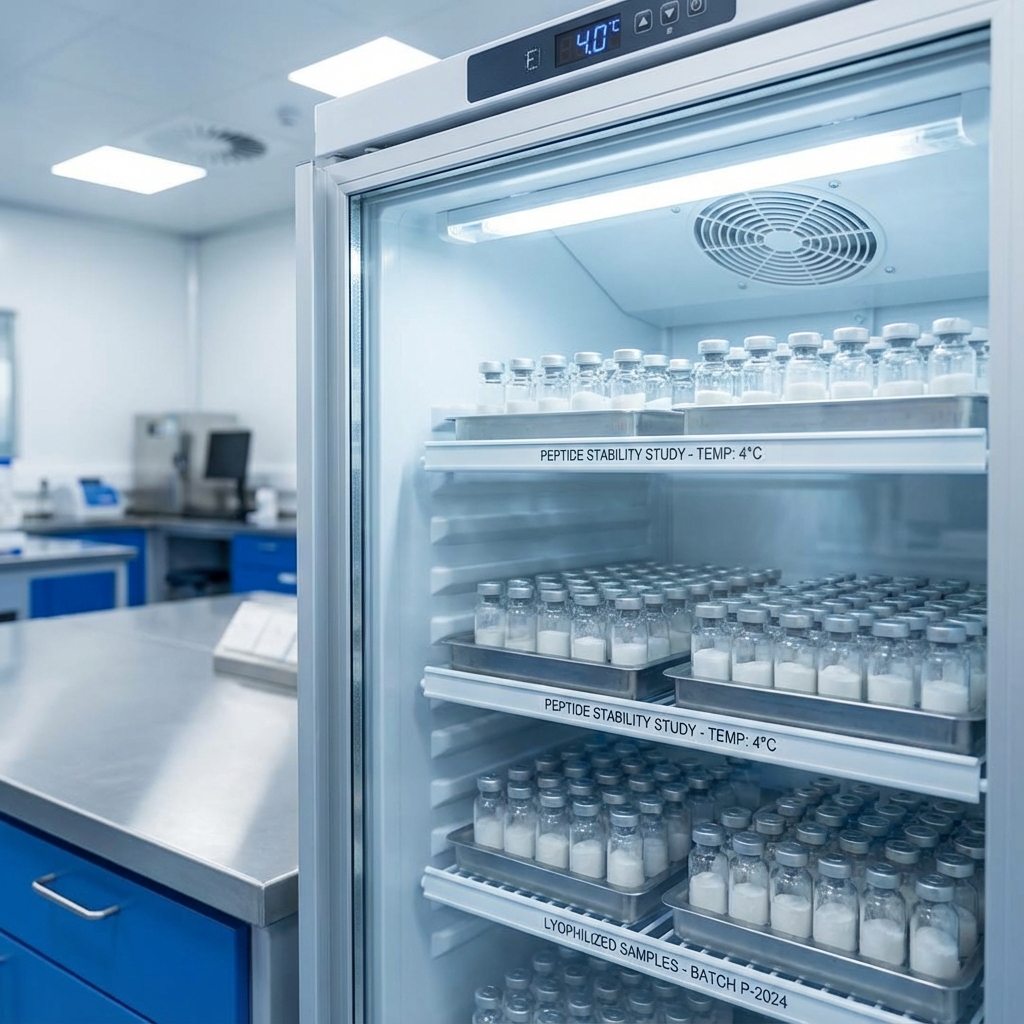
When you receive your peptides as a puck of dry powder, they are very stable.
- ** Room Temp:** Good for 4 - 8 weeks. (Shipping is safe).
- ** Refrigerator(2 - 8°C):** Good for 1 - 2 years.
- ** Freezer(-20°C):** Good for 5 + years.This is best for long - term stocking.
2. Reconstituted(Liquid Form)
Once you add ** Bacteriostatic Water **, the clock starts ticking. The presence of water creates an environment for hydrolysis and bacterial growth(though the benzyl alcohol in BAC water stops bacteria).
- ** Room Temp:** Degrades within 48 hours. ** Do not leave out.**
- ** Refrigerator:** The only option.Lasts ** 4 - 8 weeks ** depending on the peptide.
-
- Fragile:* HGH, IGF - 1, Follistatin(Use within 2 - 3 weeks).
-
- Stable:* BPC - 157, TB - 500, Melanotan II(Can last 2 - 3 months).
-
- ** Freezer:** ** NEVER.** Do not freeze liquid peptides.Ice crystals form and act like microscopic knives, slicing the peptide bonds and rendering the drug useless.
3. The "Cloudy" Test
If your solution, which should be crystal clear, suddenly turns cloudy, milky, or has floating particles:
- ** Verdict:** It has crashed out of solution or is contaminated. ** Discard immediately.**