Klotho Peptide: From Accidental Discovery to Research Applications
Discover Klotho protein mechanisms from its 1997 discovery to current research applications in metabolism, cardiovascular and brain studies.
Table of Contents
Key Research Insights
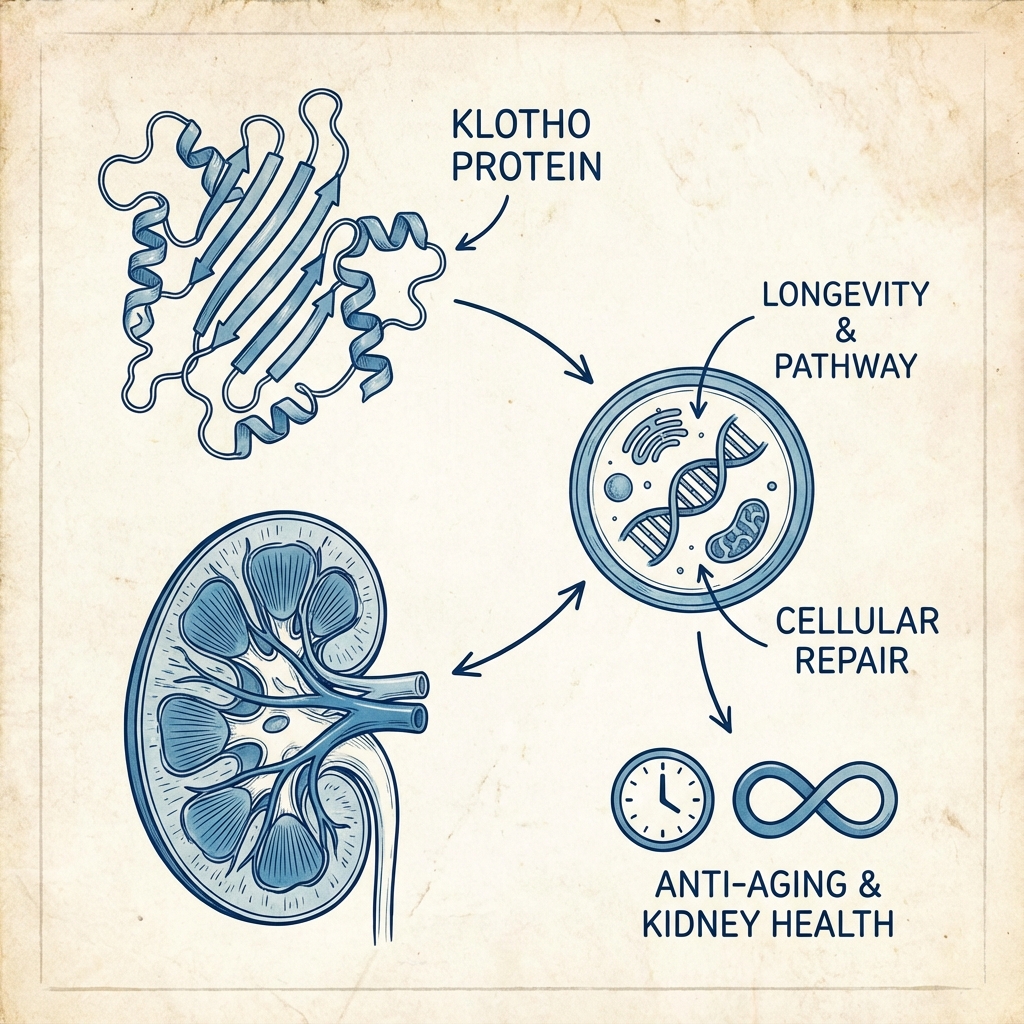
- α - Klotho functions as an obligatory co - receptor for FGF23 to regulate phosphate and vitamin D metabolism - Soluble Klotho levels decline with age and correlate with vascular health and kidney function
- The protein acts as a tumor suppressor by inhibiting Wnt, IGF - 1, and TGF - β signaling pathways
- Cognitive studies show Klotho elevation enhances synaptic plasticity and protects against neurodegeneration
The Klotho Protein Family
There are three proteins in the klotho family. α - Klotho is predominantly expressed in the kidney, specifically in the distal convoluted tubule and connecting tubule, where it modulates mineral metabolism and also acts as a systemically circulating humoral factor. β - Klotho acts as an obligate co - receptor for the endocrine hormones FGF19 and FGF21.It is expressed in metabolically active tissues, such as the liver, adipose tissue and discrete areas of the central nervous system.α - klotho acts on phosphate and calcium homeostasis via FGF23, while β - klotho regulates bile acid metabolism(FGF19) and glucose and lipid metabolism(FGF21). γ - Klotho, which is encoded by the LCTL(lactase - like) gene, is the least studied member of the klotho family.It is highly and selectively expressed in brown adipose tissue and the eye and has the capacity to act as an additional co - receptor for FGF19 in cell culture.
What is α - Klotho ?
α - Klotho is a type I single-pass transmembrane protein found in various forms. This protein has a large extracellular domain, a membrane - spanning segment, and a short intracellular domain.The extracellular domain has two internal repeat domains(KL1 and KL2) with structural homology to β - glucosidase enzymes.The protein, however, has no enzymatic activity and serves instead as a non - enzymatic scaffold. Three forms of α - klotho have been identified that serve unique research roles:
- Full - length membrane - bound Klotho(mKl) serves as a co - receptor for fibroblast growth factor 23(FGF23)
- Soluble Klotho(sKl) can be created by proteolytic cleavage by the ADAM10 and ADAM17 metalloproteases
- An alternatively spliced secreted form can also be produced and contributes to the circulating pool of the protein
- Soluble Klotho(sKl) can be created by proteolytic cleavage by the ADAM10 and ADAM17 metalloproteases
Mineral Metabolism and Calcium - Phosphate Homeostasis Research
α - Klotho serves as an obligatory co - receptor for FGF23 in regulating phosphate and calcium homeostasis. The membrane - bound form complexes with FGF receptors(primarily FGFR1c) to enable FGF23 signaling.This suppresses renal phosphate reabsorption and inhibits vitamin D biosynthesis.The FGF23 - α - Klotho axis represents a bone - kidney endocrine network where FGF23, produced by osteoblasts and osteocytes, signals through α - Klotho - expressing renal tubular cells. Soluble α - klotho directly regulates the epithelial calcium channel TRPV5 in the kidney.This regulation enables calcium reabsorption in the distal tubule through two distinct mechanisms.α - klotho increases TRPV5 cell surface expression in an N - glycan - dependent manner, while sialidase - mediated stimulation operates through lipid raft - dependent pathways independent of N - glycosylation. Studies in mice with distal convolution - specific klotho deletion showed that approximately 80 % of circulating soluble klotho originates from late distal convoluted tubule and connecting tubule cells.Loss of this source results in profound calciuria, reduced bone mineral density, and decreased TRPV5 expression.
Cardiovascular and Vascular Function Mechanisms
Klotho deficiency leads to extensive vascular calcification and stiffening in animal models.Research identifies klotho as a key defender of vascular integrity. Mechanistically, klotho inhibits phosphate - induced smooth muscle cell calcification by suppressing the uptake of phosphate and preserving differentiation markers.Lower serum klotho levels in humans correlate with increased arterial stiffness and higher cardiovascular risk. The protein also supports endothelial function. It promotes nitric oxide production and protects endothelial cells from oxidative stress.These vasoprotective properties make klotho a central target in cardiovascular aging research.
Cognitive Function and Neuroprotection Research
While primarily produced in the kidney, klotho is also expressed in the choroid plexus of the brain. Research demonstrates that elevating klotho levels enhances cognition and synaptic plasticity.In mouse models, systemic klotho treatment improved learning and memory performance, independent of age. The mechanisms involve enhancement of NMDA receptor function components(specifically GluN2B subunits) at the postsynaptic membrane.This facilitates long - term potentiation, a cellular correlate of memory formation. Klotho also promotes oligodendrocyte differentiation and myelination, which are crucial for nerve signal transmission.In models of neurodegenerative diseases like Alzheimer's and Parkinson's, klotho overexpression or treatment confers neuroprotection and reduces pathological changes.
Insulin and IGF - 1 Signaling Modulation
Klotho functions as a negative regulator of the insulin / IGF - 1 signaling pathway.This pathway is evolutionarily conserved and intimately linked to lifespan regulation. By inhibiting insulin / IGF - 1 signaling, klotho induces resistance to oxidative stress.This mechanism mirrors the effects of caloric restriction, a known lifespan - extending intervention. Mice overexpressing klotho exhibit insulin resistance but paradoxically live longer than wild - type controls.This suggests that dampened insulin signaling, mediated by klotho, contributes to longevity despite metabolic alterations.
Wnt / β - Catenin Signaling Inhibition
α - Klotho is an endogenous inhibitor of Wnt / β - catenin signaling, a pathway that regulates cell proliferation, differentiation, and tissue homeostasis. Klotho overexpression negatively regulates Wnt / β - catenin signaling by promoting β - catenin degradation and decreasing nuclear translocation.This leads to the suppression of Wnt target gene transcription through proteasome - dependent mechanisms downstream of Dishevelled(DVL). The ability of klotho to suppress Wnt / β - catenin signaling has implications for the inhibition of fibrosis in multiple tissues.In liver cancer cells, the klotho - mediated suppression of Wnt / β - catenin signaling induces apoptosis and decreases proliferation.
Inflammatory Response Regulation
α - Klotho exhibits anti - inflammatory properties through modulation of multiple inflammatory pathways and cytokine production. The protein suppresses pro - inflammatory cytokines including tumor necrosis factor - α(TNF - α), interleukin - 6(IL - 6), and interleukin - 1β(IL - 1β) through interference with nuclear factor - κB(NF - κB) signaling.Studies show that inflammatory cytokines, conversely, downregulate klotho expression through NFκB - dependent mechanisms, creating a reciprocal regulatory relationship. In glial cells exposed to lipopolysaccharide - induced inflammation, α - klotho pretreatment decreases TNF - α and IL - 6 production, reverts NF - κB activation, and reduces neuronal death induced by inflammatory mediators.The protein also modulates immune cell phenotype and function, including effects on monocytes, macrophages, T cells, and B cells.
Mitochondrial Function and Oxidative Stress
α - Klotho has multiple mechanisms by which it confers oxidative stress resistance and mitochondrial function. The protein upregulates manganese - containing superoxide dismutase(Mn - SOD) and the transcription factors FoxO and Nrf2 to activate antioxidant defense systems.Klotho affects regulators of mitochondrial function such as mitochondrial uncoupling protein 1(UCP1), B - cell lymphoma - 2(BCL - 2), peroxisome proliferator - activated receptor gamma coactivator 1 - alpha(PGC - 1α), transcription factor EB(TFEB), and peroxisome proliferator - activated receptor gamma(PPAR - gamma). Age - dependent loss of α - klotho expression in muscle progenitor cells drives mitochondrial DNA damage and a reduction in cellular bioenergetics.Restoring klotho expression to youthful levels ameliorates mitochondrial dysfunction, protects mitochondrial DNA integrity and enhances the functional regeneration of aged muscle tissue.The protein induces mitochondrial biogenesis by activating the AMPK / PGC - 1α pathway.
Tumor Suppressor Functions
α - Klotho functions as a tumor suppressor across multiple cancer types, including liver, gastric, lung, colorectal, melanoma, and other malignancies. The protein inhibits cancer cell proliferation, induces apoptosis, and suppresses tumor progression through modulation of key oncogenic signaling pathways.Klotho expression is frequently downregulated in cancer tissues through promoter hypermethylation, and reduced expression correlates with poor prognosis in many cancer types. The tumor suppressive mechanisms involve inhibition of the Wnt / β - catenin pathway, which reduces expression of proliferative genes including c - Myc and Cyclin D1.Klotho also suppresses the IGF - 1 / insulin signaling axis by reducing phosphorylation of IGF - 1 receptor, insulin receptor substrate - 1(IRS - 1), PI3K, Akt, and mTOR.