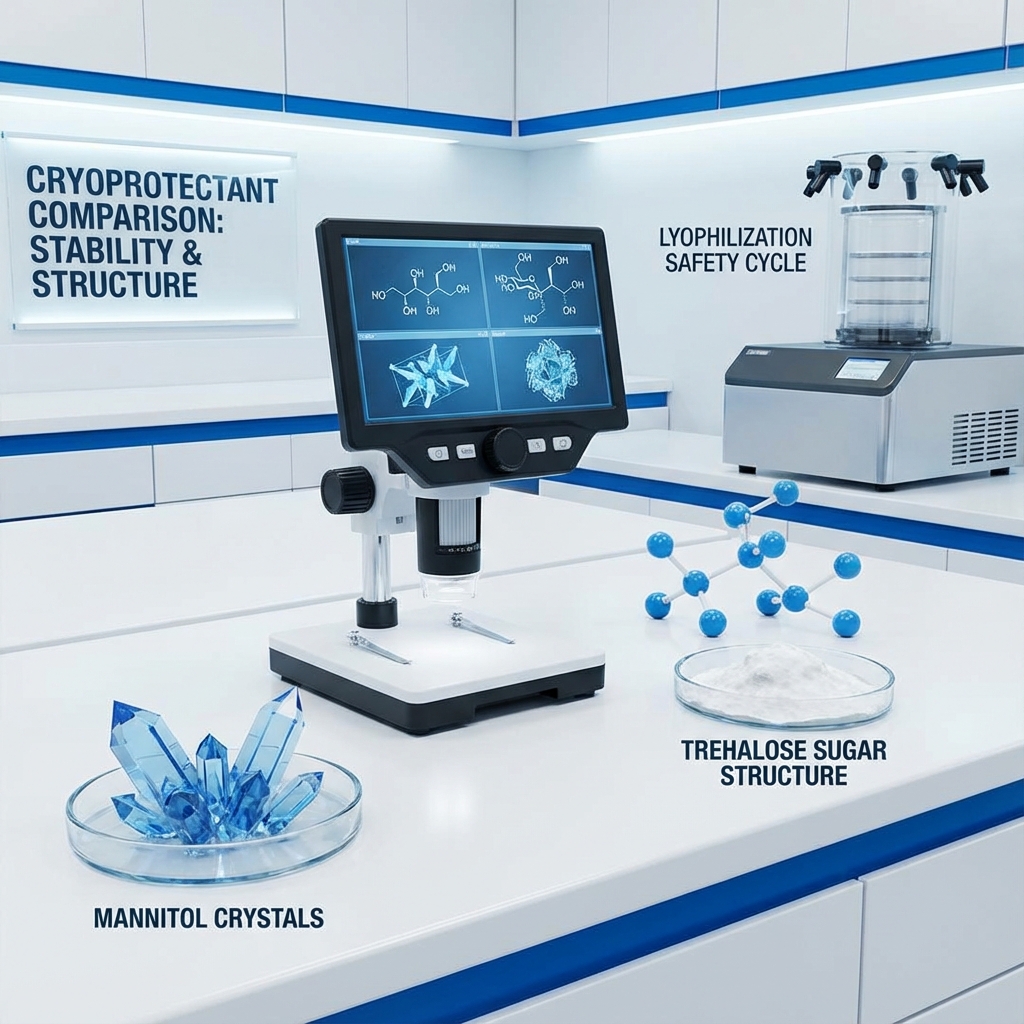
Mannitol vs Trehalose: Excipient Use in Peptide Manufacturing
Learn how mannitol and trehalose stabilize peptides through different mechanisms. See how both excipients complement each other in formulations.
Table of Contents
Quick Insights
- Mannitol and Trehalose are the two most common excipients used in peptide lyophilization - Mannitol functions as a crystalline bulking agent to provide structural support to the cake - Trehalose acts as an amorphous lyoprotectant to stabilize the peptide molecule itself - Optimal formulations often use a combination of both to achieve cake stability and bioactivity preservation
Excipients Serve Multiple Key Functions in Research Applications
In the lyophilization(freeze - drying) of peptides, excipients are not inert fillers.They play active roles in protecting the peptide during the freezing and drying processes.
Primary Stabilization Mechanisms
- ** Cryoprotection **: Protecting against freezing damage(ice crystal formation)
    - ** Lyoprotection **: Protecting against drying damage(water removal)
        - ** Bulking **: Providing physical structure to the dried product
Peptide Degradation Occurs Through Two Primary Routes
- ** Physical Instability **: Aggregation, denaturation, adsorption
    - ** Chemical Instability **: Hydrolysis, oxidation, deamidation
Mannitol Functions as a Crystalline Bulking Agent
Mannitol serves primarily as a structural scaffold that crystallizes during freezing to form a rigid framework supporting the lyophilized cake. This prevents the cake from collapsing, ensuring an elegant pharmaceutical appearance and rapid reconstitution.
Processing Advantages
Mannitol's tendency to crystallize facilitates the drying process. It creates channels for water vapor to escape, shortening the lyophilization cycle.
Polymorphism Creates Stability Challenges
Mannitol can exist in different crystal forms(polymorphs).Transitions between these forms can release energy or water, potentially destabilizing the peptide.
Trehalose Provides Direct Molecular Protection
Trehalose operates as an amorphous lyoprotectant that remains in glassy form to stabilize peptides at the molecular level. It replaces water molecules around the peptide through hydrogen bonding(Water Replacement Theory) and immobilizes the peptide in a rigid glass matrix(Vitrification Theory).
Dual Mechanisms Protect Peptides During Drying
This protection is crucial for maintaining the peptide's secondary and tertiary structure during the removal of water.
Superior Glass Properties Ensure Long - term Stability
Trehalose has a high glass transition temperature(Tg), making it very stable at room temperature.This robust glass state prevents peptide mobility and degradation over time.
Performance Comparison Reveals Basic Trade - offs
Direct comparison shows that mannitol and trehalose serve complementary rather than competing functions in research peptide formulations.
- ** Mannitol **: Best for cake structure and appearance.Poor protein stabilizer.
- ** Trehalose **: Best for protein / peptide stability.Poor cake structure(can collapse).
Combination Strategies Capture Synergistic Benefits
Combining mannitol and trehalose allows formulations that leverage crystalline structure with amorphous protection when properly controlled. By tuning the mass ratio, researchers can engineer a product that looks good(thanks to mannitol) and stays stable(thanks to trehalose).
Research Application Decision Framework
Selection Criteria for Laboratory Applications
- For simple, stable peptides: Mannitol alone may suffice.
- For complex, folding - dependent peptides: Trehalose is essential.
- For long - term storage: A combination is often preferred.
Quality Control Requirements for Research Formulations
Analytical methods such as DSC (Differential Scanning Calorimetry) and XRD(X - Ray Diffraction) are used to verify the physical state of the excipients in the final product. Ensuring the mannitol is crystalline and the trehalose is amorphous is a key quality attribute.