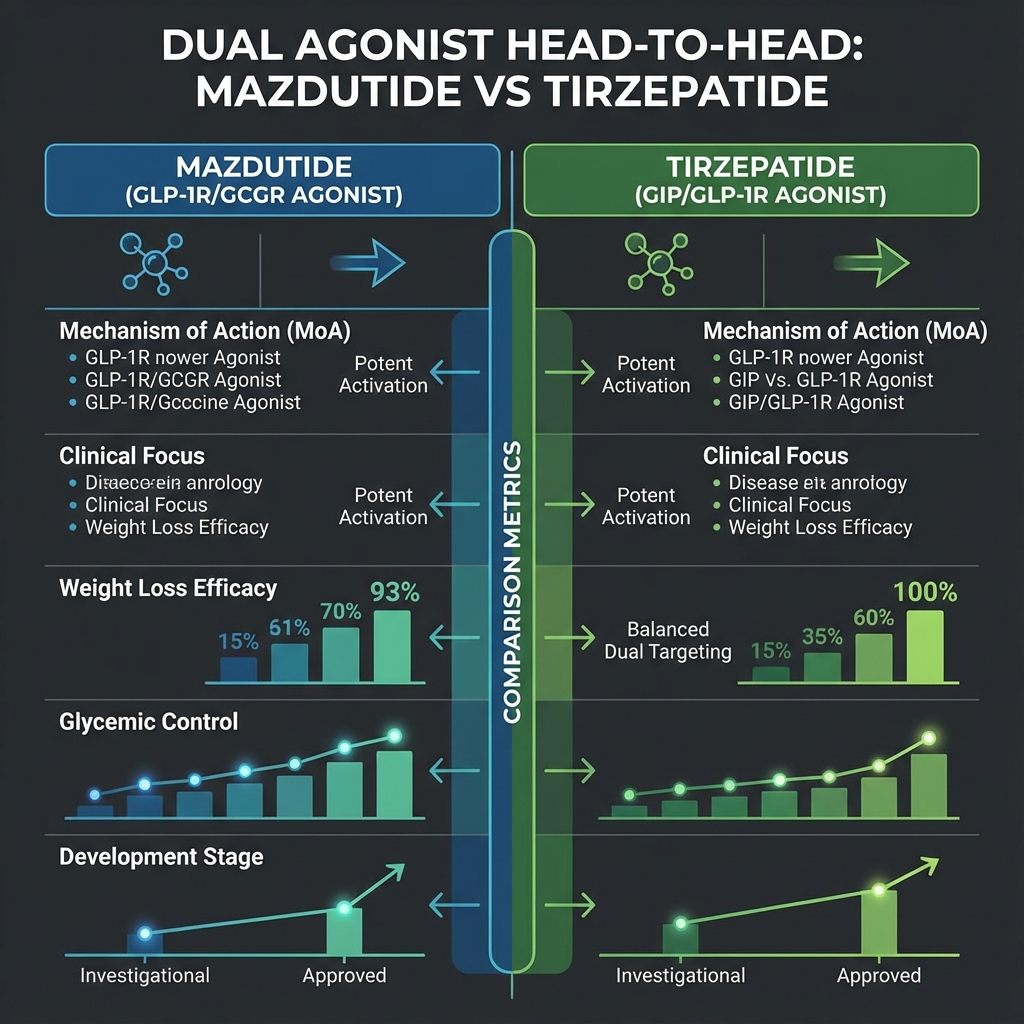
Mazdutide vs Tirzepatide: A Comparative Analysis for Weight Loss
Mazdutide vs Tirzepatide: Analysis for Weight Loss reveals which treatment offers better results for obesity and overweight management.
Table of Contents
What is Tirzepatide
Tirzepatide is an innovative injectable medication developed by Eli Lilly, approved for managing type 2 diabetes (as Mounjaro) and chronic weight loss (as Zepbound). It’s a first-in-class dual agonist targeting both GLP-1 and GIP receptors, setting it apart from single-receptor peptides like semaglutide. Its mechanism promotes insulin secretion, slows gastric emptying, and reduces appetite, leading to notable improvements in glycaemic control and body weight reduction.Clinical trials, including the SURMOUNT - 5 study, demonstrate tirzepatide’s ability to achieve ** 13.7 - 20.2 %** weight loss in individuals with obesity but without type 2 diabetes, outperforming other GLP - 1 receptor agonists in direct comparisons. Serious risks, though rare, include pancreatitis, gallbladder issues, and a potential for thyroid tumors.Administered weekly, doses range from ** 2.5 mg to 15 mg **.
What Is Mazdutide
Mazdutide(also known as IBI362 or LY3305677) is a groundbreaking peptide developed by Innovent Biologics, designed for the treatment of obesity and type 2 diabetes.It is a novel dual agonist that simultaneously targets glucagon - like peptide - 1(GLP - 1) and glucagon receptors(GCGR), distinguishing it from other incretin - based peptides like semaglutide or tirzepatide.This dual mechanism promotes weight loss by increasing energy expenditure through glucagon receptor activation while enhancing insulin secretion and suppressing appetite via GLP - 1 receptor activation. In phase II clinical trials, such as those reported in peer - reviewed journals, mazdutide demonstrated significant efficacy, achieving ** 10–14 %** body weight reduction in adults with obesity over ** 32 to 48 weeks **.For type 2 diabetes, it improved glycemic control, reducing HbA1c levels effectively.The safety profile is favorable, with common side effects including mild to moderate gastrointestinal issues like nausea and diarrhea, and a low rate of discontinuation due to adverse events.Administered as a once - weekly subcutaneous injection, mazdutide shows promise as a long - term treatment option.
Mazdutide vs Tirzepatide
Type 2 Diabetes
Both mazdutide and tirzepatide address the growing challenge of type 2 diabetes, a condition affecting millions globally, characterized by insulin resistance and increased blood sugar.Effective diabetes management requires therapies that not only lower blood glucose but also tackle associated complications like obesity.Mazdutide and tirzepatide both demonstrate significant improvements in HbA1c, fasting plasma glucose, and insulin sensitivity, making them valuable tools for patients with type 2 diabetes.However, their approaches differ. Mazdutide stands out due to its unique dual agonism of GLP - 1 and glucagon receptors, which not only enhances insulin secretion and suppresses appetite but also ** increases energy expenditure , eventually leading to weight loss. On the other hand, Tirzepatide distinguishes itself with dual GLP - 1 and GIP receptor agonism, achieving HbA1c reductions of up to ** 2.4 % and weight loss of up to ** 8.8 kg at 15 mg ** in SURPASS trials.Its GIP component enhances insulin sensitivity, making it highly effective for glycemic control.
Obesity and Weight Loss Treatment
Obesity, defined as excess body fat that impairs health, drives demand for effective weight management solutions.Mazdutide and tirzepatide both target weight loss as a primary outcome, addressing the global obesity epidemic impacting 1 in 8 people.Weight loss not only improves physical health but also reduces the risks of type 2 diabetes, cardiovascular disease, and other comorbidities. Clinical trials reveal tirzepatide’s edge in achieving higher weight loss percentages, often exceeding ** 20 %** in non - diabetic obesity patients, while mazdutide shows great results, with up to ** 14 %** weight reduction in phase II studies.Both medications slow gastric emptying and reduce appetite, but their receptor targets create nuanced differences in outcomes.
Comparing Clinical Trials
A randomized trial compared tirzepatide(10 mg or 15 mg) to semaglutide(1.7 mg or 2.4 mg) in adults with obesity but without type 2 diabetes over 72 weeks, showing tirzepatide’s superior weight loss and waist circumference reduction. Mazdutide’s phase II trial in adults with obesity or excess weight showed approximately ** 10 - 14 %** weight loss at 4 mg and 6 mg doses over 32 to 48 weeks, with ongoing phase III trials investigating higher doses and effects on type 2 diabetes. While both medications show promise, tirzepatide’s more extensive phase III data currently provides a deeper evidence base compared to mazdutide’s ongoing trials.
Mechanism of Action
Mazdutide and tirzepatide belong to the class of GLP - 1 receptor agonists. Tirzepatide’s dual GLP - 1 and GIP receptor activation enhances insulin secretion and appetite suppression, leading to significant weight loss and glycaemic control. Mazdutide, by contrast, pairs GLP - 1 with ** glucagon receptor activation **, which boosts energy expenditure, offering a complementary approach to weight reduction.This distinction makes mazdutide a unique peptide, potentially filling gaps for patients who respond less to GIP - based therapies.
Safety and Risks
Safety profiles for both medications are generally favorable but carry specific risks. Common side effects for tirzepatide include nausea, vomiting, and diarrhea, primarily affecting the gastrointestinal system.Serious concerns include pancreatitis, gallbladder disease, and thyroid C - cell tumors. Mazdutide shares similar gastrointestinal side effects but also warrants monitoring for potential cardiovascular effects due to its glucagon receptor activity, which can influence heart rate. For both drugs, discontinuation rates due to adverse events remain low, and long - term safety data continue to accumulate from ongoing trials.
Accessibility and Cost
Accessibility and cost play significant roles in treatment choices.Tirzepatide, approved by the FDA as Mounjaro and Zepbound, is widely available but can be expensive, often exceeding $1,000 per month without insurance coverage. Mazdutide is currently in late - stage clinical development and has inherently limited availability outside of clinical trials.Once approved, its pricing strategy will likely compete with existing therapies, potentially offering a more cost - effective option for certain markets. Patients should consult healthcare providers and insurance plans to understand coverage and out - of - pocket expenses.
Which One Is Better ?
Determining which medication is "better" depends on individual patient needs.
** Tirzepatide ** currently offers superior weight loss efficacy and a robust clinical track record, making it a top choice for severe obesity and type 2 diabetes. ** Mazdutide ** offers a novel mechanism that increases energy expenditure, which may benefit patients who struggle with metabolic slowdown or need an alternative to GIP - based therapies. Ongoing research will further clarify their comparative long - term benefits and safety.
Conclusion
Both mazdutide and tirzepatide represent significant advancements in the treatment of type 2 diabetes and obesity.Their unique mechanisms of action—tirzepatide’s GLP - 1 / GIP dual agonism and mazdutide’s GLP - 1 / glucagon dual agonism—provide tailored options for metabolic health.While tirzepatide currently leads in proven weight loss efficacy, mazdutide’s potential to boost energy expenditure marks it as a promising contender.Future head - to - head trials and long - term real - world data will ultimately define their distinct roles in clinical practice.
FAQ
** What is the difference between mazdutide and tirzepatide ?** Mazdutide targets GLP - 1 and glucagon receptors to boost energy expenditure and suppress appetite, while tirzepatide targets GLP - 1 and GIP receptors to enhance insulin sensitivity and reduce appetite.
** Can mazdutide replace tirzepatide ?** It may serve as an alternative, particularly for patients needing increased energy expenditure, but current data favors tirzepatide for maximum weight loss.
** Is mazdutide FDA approved ?** No, mazdutide is currently in late - stage clinical trials and has not yet received FDA approval.
** Does mazdutide cause heart issues ?** Mazdutide’s glucagon activity may slightly increase heart rate, a factor being monitored closely in clinical trials.
** How much weight can you lose with tirzepatide ?** Clinical trials show weight loss of up to 20 % or more in individuals with obesity.
Want to start tirzepatide?
Mazdutide is not approved in the US. The GLP-1 medicines a US clinician can prescribe today are semaglutide (Wegovy, Ozempic, Wegovy pill), tirzepatide (Zepbound, Mounjaro), liraglutide and oral orforglipron (Foundayo). Our sister site CalcMyPeptide compares what each route costs: insurance or Medicare, brand-name direct, and telehealth.
CalcMyPeptide is our sister site (same publisher, Kymata Labs). Its comparisons list only telehealth providers whose affiliate programs we have joined or applied to, and it may earn a commission. GLP-1 medicines need a prescription from a licensed clinician.