The Basics of Peptide Modification: What You Need to Know
Learn the basics of peptide modification for in vitro research. Complete intro guide from post-translational changes to synthetic strategies.
Table of Contents
Types of Peptide Modifications
Post - Translational Modifications
Post - translational modifications represent natural changes that occur after protein synthesis in living systems.These modifications are crucial for researchers studying how cells regulate protein function and cellular processes.
- ** Phosphorylation ** targets specific amino acid residues including serine, threonine, and tyrosine.This reversible modification helps researchers understand enzyme activity and cellular signaling pathways in their experimental systems.
- ** Glycosylation ** involves adding carbohydrate groups to asparagine(N - linked) or serine and threonine residues(O - linked).These modifications enhance protein folding and stability. Common Post - Translational Modifications:
- Acetylation and methylation of lysine and arginine residues
- Ubiquitination for protein degradation studies
- Sumoylation for nuclear transport research
- Nitrosylation for oxidative stress studies
- Sumoylation for nuclear transport research
- Ubiquitination for protein degradation studies
Chemical Modifications for Research Enhancement
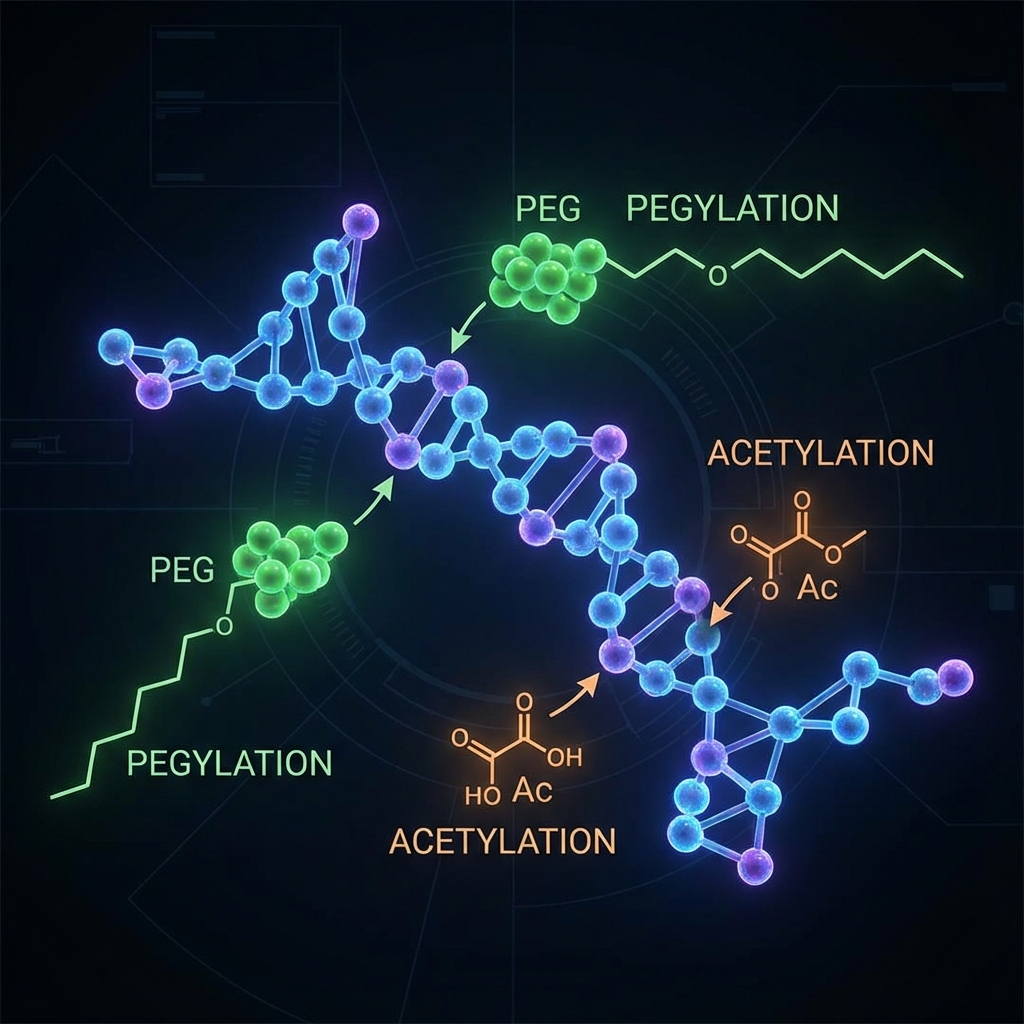
- ** PEGylation ** involves attaching polyethylene glycol chains to peptides, dramatically improving their properties for laboratory use.This modification increases molecular size and reduces degradation(proteolysis) and renal clearance.
- ** Lipidation ** strategies attach fatty acid chains to enhance membrane association.Researchers studying membrane interactions and cellular uptake often use these modifications to improve their experimental results.
- ** Cyclization ** creates ring structures that significantly enhance peptide stability and biological activity.Head - to - tail cyclization through amide bonds and side chain cyclization via disulfide bridges provide different structural options for research applications.
Solid - Phase Peptide Synthesis and Modifications
Solid - phase peptide synthesis(SPPS) advanced how researchers obtain modified peptides for their studies.This method enables efficient peptide assembly while allowing incorporation of modifications during the synthesis process. The SPPS workflow involves repetitive cycles of deprotection, washing, coupling, and final washing steps.This systematic approach ensures high - quality peptides suitable for demanding research applications. SPPS Protection Strategies:
- Boc / Bzl approach: Uses acid - labile protecting groups
- Fmoc / tBu strategy: Employs base - labile N - terminal protection
- Modern innovations: Focus on waste reduction and efficiency The process begins by anchoring the growing peptide chain to an insoluble polymer support.This allows straightforward peptide purification through filtration and washing, making the entire process more efficient for research laboratories.
- Fmoc / tBu strategy: Employs base - labile N - terminal protection
Analytical Characterization Methods
Comprehensive characterization of modified peptides requires multiple analytical techniques to ensure quality and functionality for research applications.Each method provides specific information about peptide identity, purity, and structural properties. ** Mass spectrometry ** serves as the primary analysis tool, with electrospray ionization(ESI - MS) and MALDI - TOF representing the main ionization methods.ESI - MS offers advantages for coupling with liquid chromatography, while MALDI - TOF excels in peptide mass fingerprinting applications. ** Tandem mass spectrometry(MS / MS) ** enables detailed structural characterization through controlled fragmentation.Common fragmentation techniques provide complementary information about peptide sequences and modification sites. ** Chromatographic methods ** remain essential for purity assessment and impurity profiling.Reversed - phase chromatography dominates peptide analysis due to its ability to separate peptides based on hydrophobicity differences. ** Nuclear magnetic resonance(NMR) spectroscopy ** provides detailed structural information, enabling determination of three - dimensional structure and conformational dynamics.
Quality Control Best Practices
Research laboratories require robust quality control measures to ensure consistent results with modified peptides.Identity testing confirms primary structure through amino acid sequencing and mass spectrometry verification. Purity assessment demands quantitative HPLC analysis and comprehensive impurity profiling.Researchers should establish specific acceptance criteria based on their intended applications and experimental requirements. Stability studies help determine appropriate storage conditions and shelf life.Accelerated stability testing under controlled temperature and humidity conditions provides valuable data for long - term storage planning. Essential QC Parameters:
- Identity confirmation through sequencing
- Purity determination by HPLC
- Water content analysis
- Residual solvent testing
- Peptide concentration verification
- Residual solvent testing
- Water content analysis
- Purity determination by HPLC