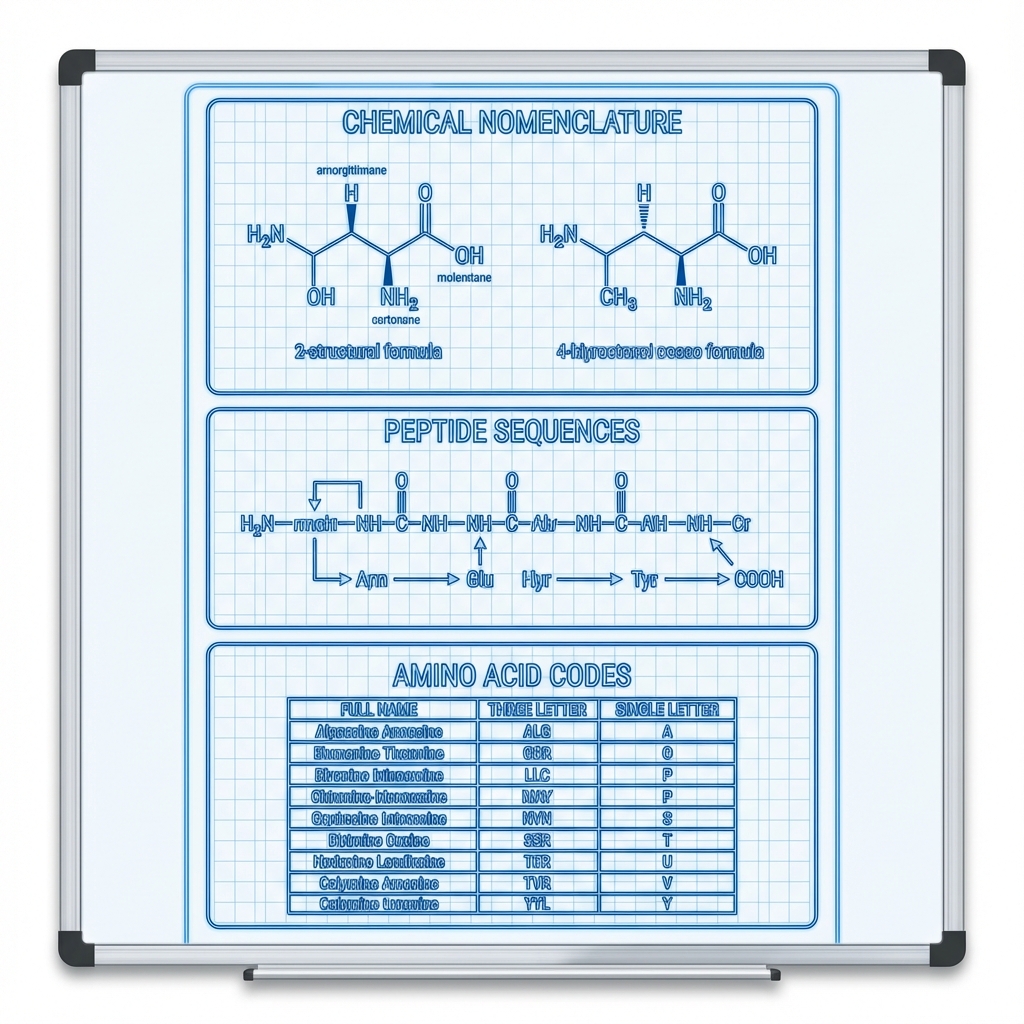
Peptide Nomenclature: Reference for Naming and Abbreviations
Complete peptide nomenclature guide for labs. Learn amino acid codes, naming rules, and IUPAC standards for accurate peptide identification.
Table of Contents
Why Peptide Nomenclature Matters for Research
Proper nomenclature prevents costly mistakes in research.When ordering peptides from suppliers, incorrect naming can lead to receiving the wrong compound entirely.Standard naming systems also ensure your published research is clearly understood by the global scientific community. The International Union of Pure and Applied Chemistry(IUPAC) and International Union of Biochemistry and Molecular Biology(IUBMB) established these guidelines to create universal consistency.Every researcher, from graduate students to senior investigators, benefits from using the same naming system.
The 20 Standard Amino Acids
Basic Amino Acid Codes
Every peptide is built from amino acid building blocks.The 20 standard amino acids each have unique three - letter and one - letter codes that form the foundation of peptide nomenclature. (e.g., Alanine = Ala = A, Arginine = Arg = R, etc.)
Chemical Classification Breakdown
Understanding amino acid properties helps predict peptide behavior in experiments.Non - polar amino acids make up 45 % of the standard set, while polar amino acids account for 30 %.Basic amino acids comprise 15 %, and acidic amino acids represent 10 %. These proportions reflect the diverse chemical environments peptides encounter in biological systems.When designing experiments, consider how these different chemical classes might affect peptide solubility, stability, and interactions.
Peptide Naming Rules
The Basic System
Peptide names follow strict rules that prevent confusion.Always write sequences from the N - terminal(amino) end to the C - terminal(carboxyl group) end, reading left to right.This convention mirrors the direction of protein synthesis in cells. For systematic naming, all amino acids except the C - terminal residue use their acyl forms(ending in -yl).The C - terminal residue keeps its full amino acid name.Each peptide bond creates an amide linkage between the carboxyl group of one amino acid and the amino group of another.For example, Gly - Ala becomes glycylalanine.
Two Abbreviation Systems
** Three - Letter System:**
    - Best for sequences up to 10 - 20 residues
        - Residues connected with hyphens: His - Phe - Arg - Trp - Pro
            - First letter capitalized, others lowercase
                - Clear and readable for shorter peptides, from simple tripeptides to longer peptide chains

                    ** One - Letter System:**
                        - Used for longer sequences and proteins
                            - No separators needed: HFRWP
                                - More compact for database storage
                                    - Essential for bioinformatics applications and polymer analysis
Modifications and Special Notations
Common Modification Types
Research peptides frequently contain modifications that alter their properties.Proper notation ensures accurate communication about these important structural features.
Notation Symbols
Understanding these symbols helps interpret complex peptide structures:
- Brackets[] indicate modifications or substitutions
- Parentheses() show connectivity or protection groups
- Superscript numbers specify residue positions
- Prefixes like D - indicate stereochemical configuration(e.g., D - Ala)
- Superscript numbers specify residue positions
- Parentheses() show connectivity or protection groups