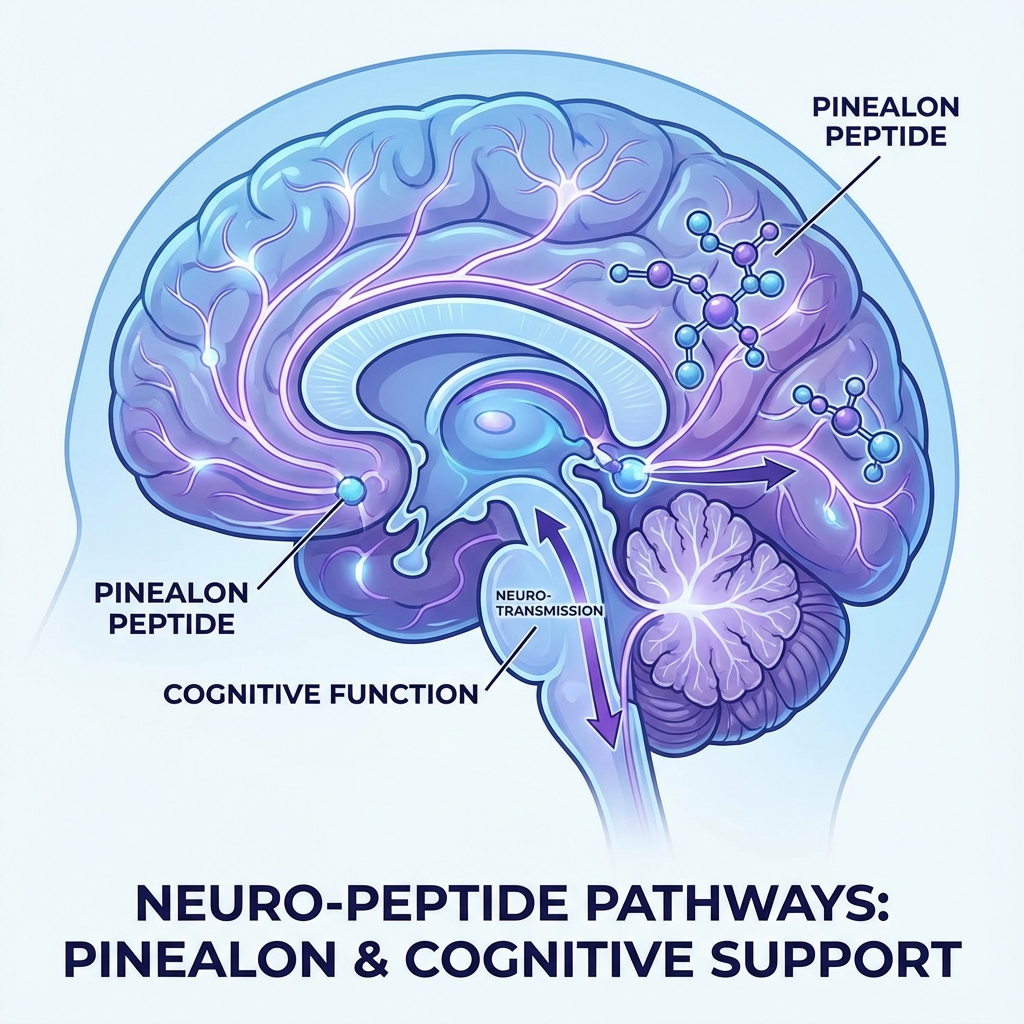
Huberman and Pinealon: What the Evidence Actually Says
Andrew Huberman says Pinealon roughly doubled his REM sleep. Here is what that report is, what the research behind Pinealon actually measures, and what to do with the hype.
Table of Contents
Short answer: Andrew Huberman has described a personal, occasional experiment with Pinealon (the synthetic tripeptide Glu-Asp-Arg, or "EDR") in which his tracked REM sleep went from about one hour to about two. That is a single uncontrolled self-report. As of October 2026 there is no published randomized human trial of Pinealon for sleep, and the mechanism data are mostly from cell and animal studies by one Russian research group. It is an interesting signal, not evidence.
Reviewed: October 6, 2026 · The Bioregulator Atlas editorial team · Sources: the PubMed records and retailer product labels listed under References.
Affiliate disclosure: The Bioregulator Atlas earns a commission when you buy through Vita-Stream links on this page, at no extra cost to you. Links marked (affiliate link) are paid links. We do not sell these products, and the commission does not change what we write.
What Huberman actually said
- On Huberman Lab with Dr. Craig Koniver, Huberman described trying Pinealon (including an injectable form combined with glycine) occasionally over several months. Men's Health quotes him: "From an hour to two hours or from an hour and thirty to nearly three hours" of REM.
- In the June 2026 episode with Dr. Abud Bakri, he said he takes it three times per month at most, often forgets for months, and was unsure whether a change in deep sleep was a disruption in sleep architecture.
- He repeated the REM story on The Diary of a CEO in September 2026, and Men's Health covered it on October 5, 2026.
What he did not say: that Pinealon is proven, that it is safe for nightly use, or that anyone should copy his routine.
What the research measures
| Question | What exists | What is missing |
|---|---|---|
| Does Pinealon improve human sleep? | One person's tracker data (Huberman); scattered anecdotes | Any controlled human sleep trial |
| How might it work? | Cell-culture and rodent studies, mostly from the Khavinson group | Human pharmacokinetics; brain-penetration data |
| Is it safe? | Short-term tolerance reports | Men's Health: "no available research looking at the safety of a pinealon injection" |
| Oral vs injected? | Russian-tradition oral capsules exist | Independent oral-absorption data for a tripeptide |
The broader Khavinson program is real and long-running. Its reviews (for example PMID 19830585 and PMID 34834147) describe short peptides as gene-expression regulators. But those reviews come largely from the originating group, and the long-term human cohorts people quote were done with injectable pineal and thymus extracts (Epithalamin, Thymalin; PMID 14523363), not with Pinealon capsules.
Why the REM report is hard to interpret
- n = 1. No placebo, no blinding, no washout.
- Expectation effects are strong for sleep, and wearables estimate REM from heart rate and movement rather than EEG.
- Carry-over. Huberman reported benefits even on nights he did not take it, which fits several explanations.
- Route. Much of his use was injected. Oral capsules are a different exposure.
Where Pinealon fits in the bioregulator landscape
Pinealon is a synthetic "Cytogen" peptide. That is a different category from the natural organ-extract "Cytomax" bioregulators, which are low-molecular-weight peptide fractions from a specific tissue. See our explainer Pinealon vs. Natural (Cytomax) Bioregulators.
If you are curious anyway, the practical points are:
- Pulsed, not nightly. Even Huberman describes occasional use.
- Talk to a clinician first, especially if you take sleep, psychiatric or blood-pressure medication, or are pregnant or breastfeeding.
- Do not stack it on top of poor sleep basics. Light, timing, caffeine and alcohol still dominate.
Where to buy, and what Vita-Stream does and does not sell
Vita-Stream lists a "PINEAL0N" Cytogen capsule (Cytogen line, sold by Vita-Stream): PINEAL0N on Vita-Stream (affiliate link). It is not part of Vita-Stream's own Vita Peptides line.
Vita Peptides, the house line, has no pineal or brain product. We say that plainly because some sites imply otherwise. The house line covers other organ systems, for example the thymus (Thymusol) or the immune-and-stress complex Vita Defender (affiliate links). Those are separate goals, not Pinealon substitutes. No human trial has tested any Vita Peptides product by name.
FAQ
Did Huberman say Pinealon is safe?
No. He described personal, infrequent use. Men's Health notes there is no published safety research on Pinealon injections.
How often does Huberman take Pinealon?
In the June 2026 Bakri episode he said three times per month at most, and he often goes months without it.
Is there a Pinealon sleep study in humans?
Not a controlled one, as of October 2026. The most-cited sleep data come from animal work.
Is oral Pinealon the same as injected Pinealon?
No. A three-amino-acid peptide faces digestion, and independent oral-absorption data are lacking.
Does Vita Peptides make a Pinealon alternative?
No. The Vita Peptides line has no pineal or brain product. Vita-Stream sells the GARMONIA PINEAL0N capsule separately.
References
- PMID 14523363: Khavinson & Morozov 2003, Thymalin and Epithalamin (injectable extracts) in elderly people. https://pubmed.ncbi.nlm.nih.gov/14523363/
- PMID 19830585: Anisimov & Khavinson 2010, peptide bioregulation review (Biogerontology). https://pubmed.ncbi.nlm.nih.gov/19830585/
- PMID 34834147: 2021 systematic review, peptide regulation of gene expression (Molecules). https://pubmed.ncbi.nlm.nih.gov/34834147/
- Men's Health, "The Peptide Meant to Keep You in REM Sleep for Longer," Oct 5, 2026. https://www.menshealth.com/health/a73366301/what-is-pinealon-edr-peptide-andrew-huberman/
- Huberman Lab with Dr. Abud Bakri, "Peptides: The Science, Uses & Safety," June 2026. https://www.hubermanlab.com/episode/peptides-the-science-uses-and-safety-abud-bakri
Disclaimer
These statements have not been evaluated by the Food and Drug Administration. These products are not intended to diagnose, treat, cure, or prevent any disease. This article is educational and is not medical advice. Talk to a qualified healthcare professional before using any supplement, especially if you are pregnant or breastfeeding, take medication, or have a health condition.
Affiliate disclosure: we earn a commission on purchases made through Vita-Stream links on this page.